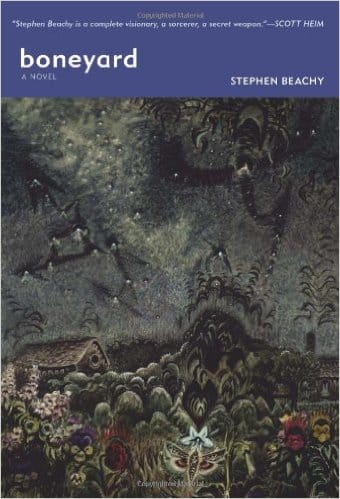
I am only a boy in a city full of trees, but every night I journey. While the other children of the city lie asleep and dreaming, I travel through the blue moonlight or the hushed, severe dark if there is no moon. In the moonlight, our city looks like it was infused with a luminous powder from another world. Without the moon it is just a shabby darkness of houses and trees under the permanent haze of sky. There are no people and no cars in the night, but sometimes there is one car that slows down as it passes me by, as if checking me out...

More about boneyard

Although my name will be on the cover of this book, the actual author is a boy - I'll call him Jake Yoder, although that isn't his real name - I met in 2006 when he was 14 or maybe 15 years old. I've written a fictionalized version of my encounters with Jake (See Glory Hole, where he appears as Amos) but this is probably not the place to scrupulously disentangle the fictional version from the truth - and anyway, a lot of the details have become confused in my own mind.

I met Jake in the process of working on an article about the shooting in the Amish schoolhouse in Nickel Mines, Pennsylvania. On October 10, 2006, milkman Carl Roberts walked into that Amish schoolhouse “talking nonsense” according to one of the children. He told the children that if they did what he asked, nobody would be hurt, and he sent out the boys, leaving ten girls in the school, aged 6 to 13. When the police showed up, he shot the ten girls and himself, and five of the girls died. Roberts' infant daughter had died years before, and he'd never gotten over it. In letters he left behind, he also claimed that he'd molested two young relatives when he was 12, and was haunted by dreams of molesting again. His relatives denied the story, but Roberts took sexual lubricant to the school, and it's assumed that he was intending to molest the girls before he killed them. He was living out the clichés that fuel murderous dreams: innocence ruined, a flower destroyed in earliest bloom, a gob of spit in the face of an indifferent God.

Jake told me that he'd attended the school there and that one of the girls was his sister. It seems that he did attend the school there for a brief period during the year before the shooting, but I discovered that he wasn't actually related to any of the dead or wounded girls. Should I believe anything he told me? He said he was born into an Amish family. He told me that his father died in an accident “on the road” when he was very young; his father's horse-and-buggy was smashed by a wayward SUV - Jake claimed it was a hybrid, although, given the timeframe, I don't think that's actually possible. He told me that a few years later his mother left her Amish family and ran off with a man. The details about this man were always vague, although it was clear that he'd worked at least partially as a driver for the Amish, carrying vanloads of them from here to there. Was he an evangelical preacher? A tv celebrity? A police detective? He was enough of a sinner that Jake's mother was shunned by her family. He was probably divorced, in which case he would have been considered an adulterer. Jake and his mother and her new man lived in Des Moines and possibly in the Ozarks, in southern Missouri and northern Arkansas. According to Jake, his mother worked as a nurse. At some point, probably when Jake was 11 or 12, she drowned herself.

It is sometime afterward that he wrote these stories. It was never possible for me to map out an entirely logical timeframe for Jake's life from 11 to 13, but it seems that he bounced around between his stepfather in Des Moines (the preacher or celebrity or detective, who no longer wanted him), his Old Order Amish maternal grandparents near Kalona, Iowa, his slightly less restrictive Old Order Amish paternal grandparents in Lancaster County, Pennsylvania, and possibly (I'm just guessing here) some mental institutions, juvenile homes and foster families. At the time I met him, he claimed to be living with an ex-Amish cousin (the member of a local rock and roll band, Wrath of God) in Des Moines and sometimes with his cousin's band mates in Iowa City. He was an avid reader of Argentinean fiction.

The facts he never directly stated seem equally clear: he was infatuated with the sixth grade teacher in a school he'd once attended, he was a precocious speller and writer, and a deeply troubled boy.

Probably because I was the first “author” Jake had ever met, and because I was also connected to the Amish community, (child of Mennonites, grandchild of Old Order Amish) he gave me his stories to read. We met on four different occasions in October and November of 2006 (in my novel it's compressed into only two). The last time we met was in an abandoned building near his grandparents' farm in Riverside, Iowa, that had once been used as an orphanage. It was a cold night and Jake had built a fire in the old fireplace. I'd read his entire manuscript at that point and was ready to discuss the stories, but I wasn't prepared for his own change of heart. As he roasted marshmallows, gazing dreamily into the fire, often letting the marshmallows crisp well past the golden brown stage into hideous looking blackened husks, he explained to me that his stories had somehow caused the shootings at Nickel Mines. Having convinced himself that his stories were not only “evil” but “magical”, he threw the entire manuscript onto the fire and ran wailing into the night. Despite my best efforts, I never saw Jake again, although I've spoken to him on the phone and we've exchanged several brief letters. I was able to salvage his manuscript, but with significant portions of every single page charred and blackened and sentences or whole paragraphs completely illegible.

Shortly afterward, Jake went back to live with his grandparents and was baptized in the Amish church. Like Isidore Ducasse (better known as Comte de Lautreamont), Joris-Karl Huysmans and Hugo Ball, Jake renounced his evil literary experiments and retreated into a traditional form of Christian faith. Of course nobody is much interested in Lautreamont's song of the good, Huysman's late novels about Catholic faith or in Ball's post-Dada studies of Christian mystics. When I last spoke to Jake, I asked if he was writing anything at all, and he confessed that he'd published a short piece, under a pseudonym, in Amish Family Life magazine. Although he now doesn't approve, not only of his own work but of literature in general, Jake has given me permission to do whatever I want with his manuscript as long as I don't use his real name. As a practicing member of the Amish church, the sort of recognition he might achieve as an author could only be understood as sinful, self-aggrandizing egoism. When I last spoke to him he did admit, however, that he still reads Borges at times, whom he considers a godly man. Needless to say, I don't think he entirely understands the texts.

I have done my best to rewrite the text using the charred pages and my memory of the original, although I'll be the first to admit that the process has demanded the use, at times, of my own invention.

Jake never titled anything. The title of the novel is mine, not his, and not my first choice. I did not give the “stories” individual titles as it was my sense that they made up one indivisible work. The titles of the two separate sections are also mine, although the quotes from the Notorious B.I.G., Ireneas, and Francis Picabia, and the illustrations from The Martyr's Mirror, are just as Jake had situated them.

More about boneyard

You can read the first chapter of boneyard at blithe house quarterly
